Lupine Publishers | Journal of Surgery & Case Studies
Surgical infections are a serious cause of morbidity and
mortality. Infections within vascular surgery pose a serious threat
not only to limb but also to life. For example, graft infection can result
in widespread systemic infection, sepsis and death. The incidence
of prosthetic graft infections has been shown to vary from 1 to 6%
[1]. However, the morbidity associated is strongly related to the site
of surgery and operation performed with studies demonstrating
a 21% early operative mortality and 50% 5-year mortality with
an infected prosthetic aortic aneurysm repair [2]. Antibiotic
prophylaxis is used within surgery to minimise these complications
and ultimately improve mortality. The Scottish Intercollegiate
Guidelines Network (SIGN) has assessed the requirement for which
vascular operations require antibiotic prophylaxis. In their most
recent guideline antibiotic, surgical procedures are grouped into
surgical specialities to determine whether antibiotic prophylaxis is
recommended, to be considered or not required [3].
Common risk factors for surgical site infections such as poor
nutritional status, diabetes mellitus, smoking and extremes
of age are also discussed; all common to those suffering with
peripheral vascular disease. Analysis of the Society for Vascular
Surgery Vascular Quality Initiative Registry from 2003 to 2012
demonstrated an overall in-hospital surgical site infection rate after
lower extremity bypass of 4.8% for 7908 procedures [4]. However,
the incidence of surgical site infections been noted to be as high
as 32% [5]. NHS Grampian’s ‘Antibiotic Prophylaxis in Vascular
Surgery’ guideline was created based upon the SIGN guideline in
conjunction with the Head of Service and the Chair of Antimicrobial
Management Team. They determined which antibiotics should
be administrated according to the surgery performed and local
antimicrobial guidelines. This guideline, found on the NHS
Grampian intranet, should be adhered to in all vascular operations.
Our aim was to audit the antibiotics used and the timing of
administration for all elective vascular surgeries in Aberdeen Royal
Infirmary (ARI) and compare them to the NHS Grampian ‘Antibiotic
Prophylaxis in Vascular Surgery’.
Materials and Methods
Ethical Considerations
A retrospective service data review was carried out in ARI.
No ethical approval was required as information was collected for
audit purposes only. The audit was approved by the NHS Grampian
Quality, Governance and Risk Unit and registered onto the Clinical
Effectiveness Database: Project ID 3813.
Data Collection and Analysis
Data were collected retrospectively from the elective vascular
theatre in ARI. Patients were identified using the elective vascular
theatre logbook. Only elective patients were included in the audit.
The electronic system and paper case records were analysed
to obtain the operation note, anaesthetic records, allergies and
drug prescription chart. Data collected included: gender, age,
antibiotics prescribed prior and during theatre, administration
time of antibiotics, allergies and operation and start and finish time
of each operation. The first audit cycle ran from February-March
2017 inclusive. The standard assessing what antibiotic prophylaxis
is required was compared against NHS Grampian’s ‘Antibiotic
Prophylaxis in Vascular Surgery’, which is based upon SIGN 104
guideline [Appendix]. The information audited included antibiotic
choice and timing of its administration. The guideline was sent
to all vascular consultants, registrars and core trainees as well as
the vascular anaesthetists on three separate occasions and placed
within the vascular ward doctors’ room and theatre. The audit cycle
was then repeated from May-June 2017 inclusive. The standard
assessing what antibiotic prophylaxis is required was compared
against NHS Grampian’s ‘Antibiotic Prophylaxis in Vascular Surgery’,
which is based upon SIGN 104 guideline [Appendix 1]. Data were
then recorded into a spreadsheet using Microsoft Excel 2013 and
analysed.
Results
Demographics
The first audit cycle included a total of 60 elective operations
and the second audit cycle included 64. The patient demographics
of both cycles are demonstrated. The operation category was
divided up according to the NHS Grampian policy; abdominal and
lower limb arterial reconstruction, carotid endarterectomy, lower
limb amputation, upper limb renal access and those that did not fit
into a specific category.
First Audit Cycle
Operations
In total, 5% of operations did not correspond to a category
within the NHS Grampian guidelines (n=3). This included a biopsy
of a foot ulcer and two tie off brachiocephalic fistula operations.
Antibiotics Compared to Guideline
Figure 1: First audit cycle: antibiotics prescribed according to guideline for individual operations.
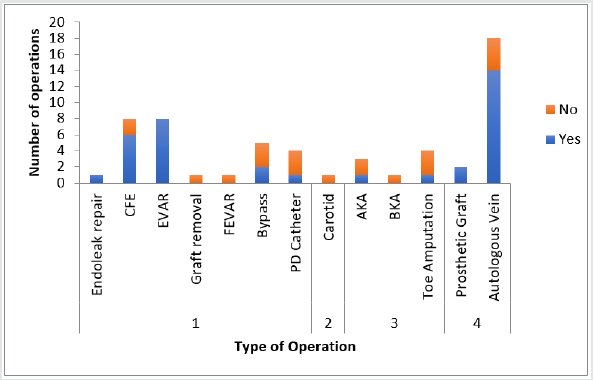
1= Vascular surgery (Abdominal and lower limb arterial reconstruction)
2 = Carotid endarterectomy
3 = Lower Limb amputation
4 = Upper limb renal access
CFE = Common Femoral Endarterectomy, EVAR = Endovascular Aneurysm Repair, FEVAR = Fenestrated Endovascular
Aneurysm Repair, PD = Peritoneal Dialysis, AKA = Above Knee Amputation, BKA = Below Knee Amputation
Of a total of 60 operations, 5% did not correlate to a category
within the guideline (n=3). Of the 57 that did, 63% received
antibiotics according to NHS Grampian guidelines (n=36), 21%
were prescribed antibiotics that were different (n=12) and 16% did
not receive antibiotics (n=9). Figure 1 demonstrates a breakdown
of individual operation categories according to whether or not the
antibiotics prescribed adhered to guideline (Figure 1).
Different Antibiotics
There were 12 cases that had antibiotics prescribed that were
different from the guideline. Of these, 58% were not compliant
due to the avoidance in prescribing gentamicin (n=7), 25% were
prescribed benzypenicillin and gentamicin as per guideline but
without the addition of flucloxacillin (n=3) and 8% missed out
appropriate Gram-negative cover (n=1).
Timing of Antibiotics
Of those operations that received antibiotics, 79% were
administrated ‘At induction, ≤60 minutes before incision’ as per
guideline (n=37), 19% of antibiotics were given too late (n=9) and
2% were given too early (n=1).
Second Audit Cycle
Operations
A total of 28% of all operations did not fit a specific category
(n=18). This included a biopsy of a foot ulcer, closure of a fasciotomy,
vein operations, antecubital fossa wound debridement, cervical
rib resections, thigh loop access graft, incision and drainage of a
brachiocephalic fistula abscess and an excision of a prosthetic graft.
Antibiotics Compared to Guideline
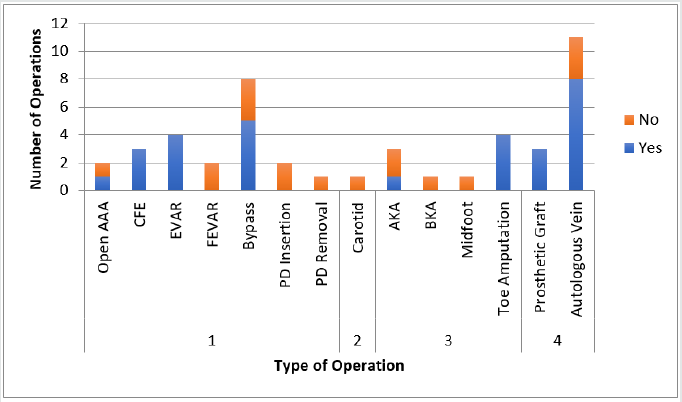
Of the 64 operations, 28% had no antibiotic guideline (n=18).
Of the 46 that did, 63% received antibiotics according to guideline
(n=29), 28% had different antibiotics prescribed (n=13) and 9%
did not receive antibiotics (n=4). Figure 2 demonstrates individual
operations and their correlation of antibiotics prescribed according
to guideline (Figure 2).
Figure 2: Second audit cycle: antibiotics prescribed according to guideline for individual operation
(For abbreviations see Figure 1).
AAA = Aortic Aneurysm Repair
Different Antibiotics
In total, 12 cases had antibiotics prescribed that were different
from guideline. A total of 58% were not compliant due to the
avoidance in prescribing gentamicin (n=7), 17% were prescribed
benzypenicillin instead of flucloxacillin (n=2), 8% missed out the
addition of flucloxacillin (n=1), 8% did not have appropriate Grampositive
cover (n=1) and 8% gave gentamicin when it was not
needed (n=1).
Timing of Antibiotics
A total of 88% of all antibiotics prescribed were administrated
according to guideline (n=30), 9% of antibiotics were given too late
(n=3) and 3% of antibiotics were given too early (n=1).
Discusión
The audit reveals important data determining whether local
guidelines for antibiotic prophylaxis, during vascular surgery,
are being accurately followed. The Getting It Right First Time
(GIRFT) is a national programme focused at reducing unwarranted
variations and ultimately improving patient care [6].Through the
use of local and national collaboration medical professionals are
able to analyse results and improve service management. This
process is further strengthened by assessing local guidelines and
implementing change. Thus, the results of this audit come at a
time when post-operative infection rates are at the forefront of the
public and governmental interest.
Data Recording
Accurate documentation is key not only for patient safety but
also for correct patient management. NHS England has revealed
their ‘Five Year Forward View’, which outlines the national target
that all documentation be electronic by 2020 [7]. This is intended
to improve communication between health care providers, allow for ‘real-time digital information on a person’s health and care’,
reduce cost and improve patient safety [8]. During the first audit
cycle, 15% of all anaesthetic records and 48% of all operation
notes were not uploaded to the electronic system. These initial
results are concerning as accurate documentation enables medical
practitioners to record complications making future interactions
safer. Additionally, with the current ageing population and demands
upon healthcare, clinicians are constantly under pressure to reduce
the ever-expanding waiting times. This is often achieved with postoperative
appointments carried out by different clinicians and
more junior staff. Therefore, it is important that all records be easily
accessible. These results were highlighted to clinicians and the
second audit cycle saw a vast improvement: only 5% of anaesthetic
records and 17% of operation notes were not uploaded.
Deviation from Protocol
Another area highlighted by the audit was the lack of
documentation regarding the reasons for not using appropriate
guidelines. The GMC states that: ‘Clinical records should include
relevant clinical findings, the decisions made and actions agreed,
and who is making the decisions and agreeing the actions, the
information given to patients, any drugs prescribed or other
investigation or treatment, who is making the record and when [9].
Thus, decisions regarding differing antibiotic prescriptions require
accurate documentation. This allows clinicians to realise that the
change from protocol is intended and enables others to understand
the rationale behind this. The first audit cycle revealed that 21% of
antibiotics were prescribed against protocol with 16% of operations
receiving no antibiotic cover. Despite clinician awareness of the
current NHS Grampian guidelines increasing throughout the audit
intervention, the second cycle revealed similar figures with 28%
of antibiotics being prescribing against protocol and 9% of all
operations not receiving antibiotics.
The insertion and removal of peritoneal dialysis catheters was
a common area of wrongful prescribing. Literature strongly links
the insertion of peritoneal dialysis without antibiotic prophylaxis
with an increased risk of peritonitis [10]. The International Society
of Peritoneal Dialysis recommends in their guidelines the use of
antibiotic prophylaxis in peritoneal access with strong evidence for
vancomycin [11]. No guidelines exist for the removal of a peritoneal
dialysis catheter and antibiotic prophylaxis. This recommendation
should be considered when updating the current guideline with a
separate section added for peritoneal dialysis. Another area that
saw a deviation from protocol was when individuals prescribed
either benzylpenicillin instead of flucloxacillin or missed out the
addition of flucloxacillin when benzylpenicillin was being used. It
is unclear why this was the case as accurate documentation was
scarce. One could assume that a lack of understanding regarding
the differing organisms covered by each antibiotic could play a role.
Thus, further investigation into why this occurred and education
into why these antibiotics are included in the current guideline
should occur.
Gentamicin
Concerns raised by both the anaesthetic and vascular
team included the reluctance to use nephrotoxic antibiotics in
procedures associated with high renal injury, such as, those
undergoing contrast or requiring clamping of renal vessels. In the
current guideline the first- and second-line antibiotic for abdominal
and lower limb arterial reconstruction includes gentamicin, a
well-known nephrotoxic. 58% of non-compliance in both the
first and second cycle was due to the omission of gentamicin. In
these cases, individuals were either prescribed teicoplanin alone
or metronidazole instead. Single-dose prophylactic gentamicin
has been extensively researched with many articles reporting its
safety, as toxicity is associated more with therapeutic level duration
rather than peak levels.10 However, a study by Nielsen et al. found
an increased incidence of acute kidney injury in patients receiving
single-dose prophylactic gentamicin during cardiac surgery, but
no greater increase in postoperative dialysis or mortality [12].
When considering the administration of gentamicin clinicians must
remember the risk factors for its toxicity: older age, reduced renal
function, dehydration and concomitant use of diuretics or iodide
contrast media [13]. Importantly, these risk factors are present in a
substantial proportion of vascular patients. Interestingly, in the NHS
Lanarkshire ‘Antibiotic Prophylaxis in Vascular Surgery’ guideline,
clinicians are asked to consider reducing the dose of gentamicin
from 80mg to 40mg or omitting altogether in patients who are at
risk of developing an acute kidney injury [14]. This poses several
questions: is the current 120mg dose of gentamicin required or is a
smaller dose as effective; should we reduce the dose in patients at
risk of an acute kidney injury and could other antibiotics with less
nephrotoxicity be considered?
Reclassification as Angiogram Procedures
The risk of surgical site infection (SSI) depends on the type of
operation and site. Open procedures carry a greater risk of SSI due
to the larger wound created and the exposure of viscera compared
to those carried out via angiogram. Skin commensals differ greatly
for vascular interventional radiology procedures such as digital subtraction angiograms. Patients within NHS Grampian are most
commonly prescribed flucloxacillin and guidelines are currently
being developed for these procedures. The argument remains
whether patients undergoing Endovascular Aneurysm Repair
(EVAR) should be classified according to these interventional
guidelines rather than as abdominal and lower limb arterial
reconstruction surgery due to the lack of abdominal viscera
exposure, thus avoiding the use of nephrotoxics.
Antibiotic Timing
The timing of antibiotics is important to guarantee efficacy
and reduce SSI. The optimal administration of antibiotics is within
60 minutes prior to skin incision with the odds of SSI rising
significantly out with this time frame [3]. The correct timing of
antibiotic administration improved from 79% within the first audit
cycle to 88% in the second.
Categorisation
In the first audit cycle 5% of operations could not be categorised
compared to 28% of operations within the second. Anterior
cervical rib resection for thoracic outlet obstruction is a procedure
commonly carried out in ARI, however, this procedure has not been
categorised. Similarly, the treatment of varicose veins is commonly
carried out and this too fails to be categorised. Although it is not
possible to ensure that every procedure fits into an operation
category it is important that common operations are grouped so
that appropriate antibiotic prophylaxis can be prescribed.
Conclusion
This audit of antibiotics within intraoperative vascular surgery
demonstrates interesting results. A clear improvement has been
made in data recording, antibiotic timing and antibiotic coverage.
However, the results show no clear difference in antibiotics
prescribed according to guideline. This could be explained, in part,
by the reluctance of clinicians to prescribe nephrotoxic antibiotics
as well as the lack of clear categorization of certain procedures.
Thus, an update of the current guideline is required to improve
antibiotic prescription and patient care. In an era of Antibiotic
Guardianship, it is imperative in order to reduce morbidity and
mortality that appropriate antibiotic prescribing is adhered to and
practitioners do not become complacent.
Follow on Linkedin :
https://www.linkedin.com/company/lupinepublishersFollow on Twitter :
https://twitter.com/lupine_online


